Analytics
Many people use a workout log just as a glorified notes app for remembering what they last lifted. While that is definitely an important aspect, we believe it’s even more important to see how you’re progressing.
That is why we’re obsessed with making Plates an analytical powerhouse. As lifters we need to see if our lifts are progressing, stalling, or regressing. We need to see how well we’re hitting the muscle groups we care about. That is the only way to improve, and Plates knows that.
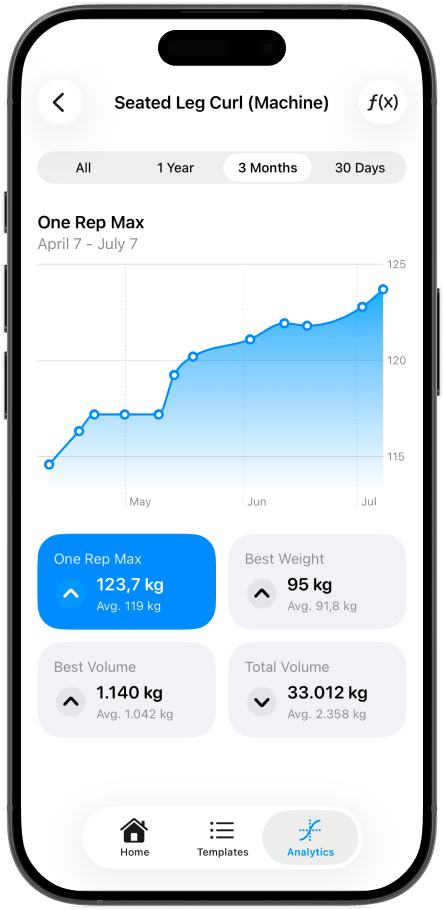
Exercise Analytics
Per-exercise breakdown of your 1RM, Best Weight, Best Volume, Total Volume, Duration, and more.
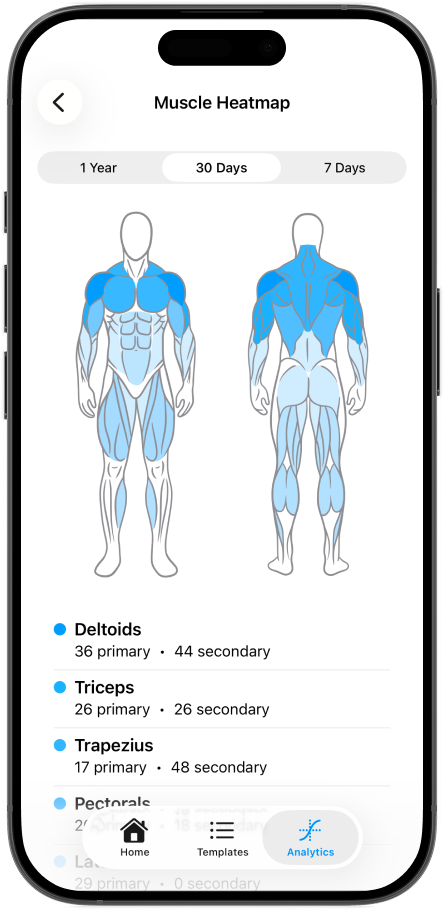
Muscle Heatmap
A muscle map that tells you exactly what muscles you’ve hit, how efficiently, and what you’re neglecting.
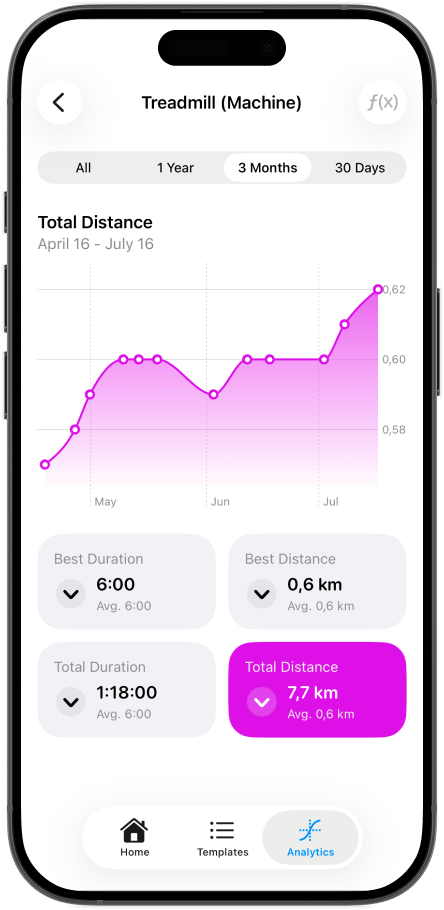
Adaptive Tracking
Different exercise types show tailored metrics—from cardio distance and duration to weighted 1RM and volume.
Frequently Asked Questions
How far back does the exercise analytics history go?
Forever. Your data never expires, and you can easily filter your stats by 30 days, 3 months, 1 year, or your entire history.
What kind of 1RM (One Rep Max) formulas does Plates have?
You can choose between Epley, Brzycki, Lombardi, Wathen, or select the average setting to get a balanced calculation across all four.
Do different exercise types show different analytics?
Yes. Cardio exercises show distance and duration stats. Isometric exercises show duration. Weighted exercises show weight, volume, and 1RM. It adapts to what you're tracking.
What kind of metrics does Plates track?
Plates tracks different things based on the parameters of the exercise, but we track 1RM, weight, volume, duration, steps, distance, and more.
See your progress
7-day free trial. Start logging and watch the analytics build.

$19.99 one-time purchase after trial